Glashütte has been a center of German watchmaking for well over 100 years, ever since Ferdinand Adolph Lange got financial support from the state government of Saxony to create a hub of watchmakers in the small town in the Ore mountains. Previously, the town had been one of mining operations, with families moving in to mine the natural resources in that region of Germany, but after the boom of mining died down, new economic ways were sought out, and a group of Dresden-based watchmakers seized the opportunity.
The history of Glashütte is fascinating and warrants a whole article to itself, but that is not what the focus is on today. As the title suggests, we will be talking about one of the legendary brands from Glashütte, Union Glashütte.

All the way back in 1845, a man by the name of Johannes Dürrstein was born in the small town of Niederrad, at the time it was separate from Frankfurt, but in the centuries since, it has been incorporated into the greater city. Funny to mention that in the same year of 1845, Ferdinand Adolph Lange received the financial support mentioned in the introduction. Dürrstein became a great tradesman as he earned a lot of experience by working as a sales associate at Ludwig & Fries, who were watchmaking suppliers in Frankfurt. This led to him making great relations with manufacturers and consumers in the world of watches.
In mid-January of 1874, Dürrstein branched out from his sales associate job to start his own company. The Dürrstein & Comp was a watch wholesaler in Dresden, and to bring back the connection to Adolph Lange, in the same year of its founding, the Dürrstein & Comp took responsibility for the distribution of A. Lange & Söhne timepieces.

Here enters the story a man who was very important and influential in the founding and operations of the future Union Glashütte. Julius Bergter was a watchmaker at the legendary Moritz Großmann, which is a brand with a history that almost rhymes with Union, as it went bankrupt before being reestablished in a strong fashion that truly honors the company of old, a bit of a spoiler for the story we are telling. Julius Bergter was also a teacher at the German school of watchmaking.
A few years later, in 1893, Uhrenfabrik Union in Glashütte was formed. Dürrstein formed it with the wholesale business in Dresden, and Julius Bergter was made the director of the newly minted Union Glashütte. The logo was extremely simple, a minimalistic image of a temple; the new logo certified the originality of the Union Glashütte time pieces. They started with a bang, as in the same year of 1893, at the Chicago World Fair, they presented and sold a grand complication pocket watch.

In 1901, tragedy struck as Johannes Dürrstein passed away, and his brother Friedrich took over the company in the wake of his brother’s passing. His reign would not last long, however, as only 2 years later, in 1903, he also passed. In turn, Friedrich’s widow, Lina, would continue the company alongside her sons, and they appointed watchmaker Emil Lautert as regulator of the brand. He would then become operations manager until the brand closed down in 1925. In the years following the closing, he would be self-employed, fixing Union timepieces.
In 1936, the Union Glashütte brand was finally taken out of the German commercial register. This came about after years of decline; the ship had been sinking for a while, and Hugo Bogusch, who succeeded Julius Bergter as director in 1919, was unable to streamline production and bring the brand into the modern age. For over 60 years, the name Union Glashütte lived in the memories of those who worked for the brand and the ones that enjoyed the company of their timepieces.

From this, we turn our attention to the third Glashütte-based brand in the article. After the Second World War, Germany, along side the majority of Europe, was in bad shape. Glashütte had been bombed, and the Soviet Union started demanding that they make machines and tools. This isolation from the years following WW2 led to Glashütte needing to learn how to produce all the parts of the watches they kept producing locally, instead of importing parts. The German Democratic Republic decided soon after to combine all the watchmaking companies in Glashütte into one state-owned enterprise by the name VEB Glashütter Uhrenbetriebe, better known as GUB.
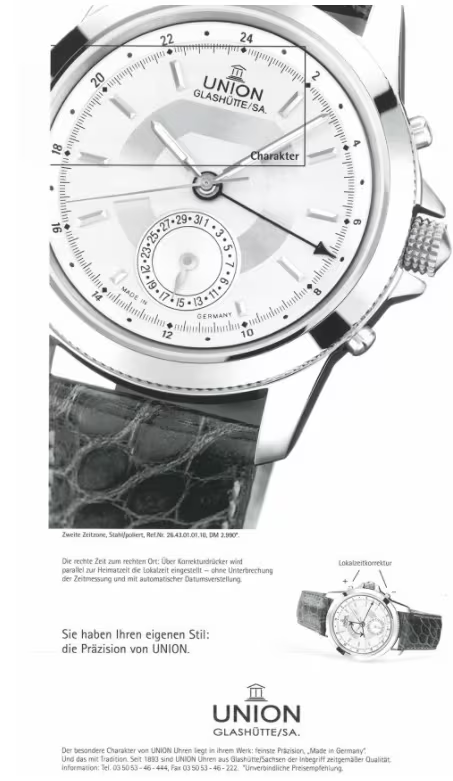
From GUB, we get to their legal successor in Glashütte Original. Thanks to Glashütte Original, Union Glashütte made a comeback in 1996, and it was reestablished as a subsidiary of Glashütte Original. Only a year later, the first wristwatches hit the market under the Union Glashütte name, but were mostly designed and produced by Glashütte Original. In the year 2000, the SWATCH group jumped in and acquired Glashütte Original, and in 2008, made the call to run Union Glashütte and Glashütte Original separately.
Union was put back in the price bracket they were famous for in the early 20th century, as they have always stood for luxury at an attainable price. Now positioned in the 1.500 – 3500 CHF range, they truly deliver on their values.
In the coming years, Union Glashütte would strike partnerships with classic car events and races, and in 2012, they moved to a brand new production facility on 5 Frühlingsweg in Glashütte. Then, 125 years on from the brand’s founding in 1893, we saw the German watchmaking museum in Glashütte honor the history of the brand with a special exhibit, and a new limited edition 1893 Jurgen Dürrstein edition was released to the public.
When it comes to the modern workings of the brand they create a lot of the parts and caliber designs in house as in 2008 SWATCH Group opened a parts factory in the town, this is mainly to help both Union and Glashütte Original reach the requirements to be stamped made in Glashütte, as the laws are relatively similar to the ones made for the swiss made distinction. In Glashütte, 50% of the components by value must be made in Glashütte, so they currently create the more expensive parts there while getting others from the standard SWATCH ETA manufacture.
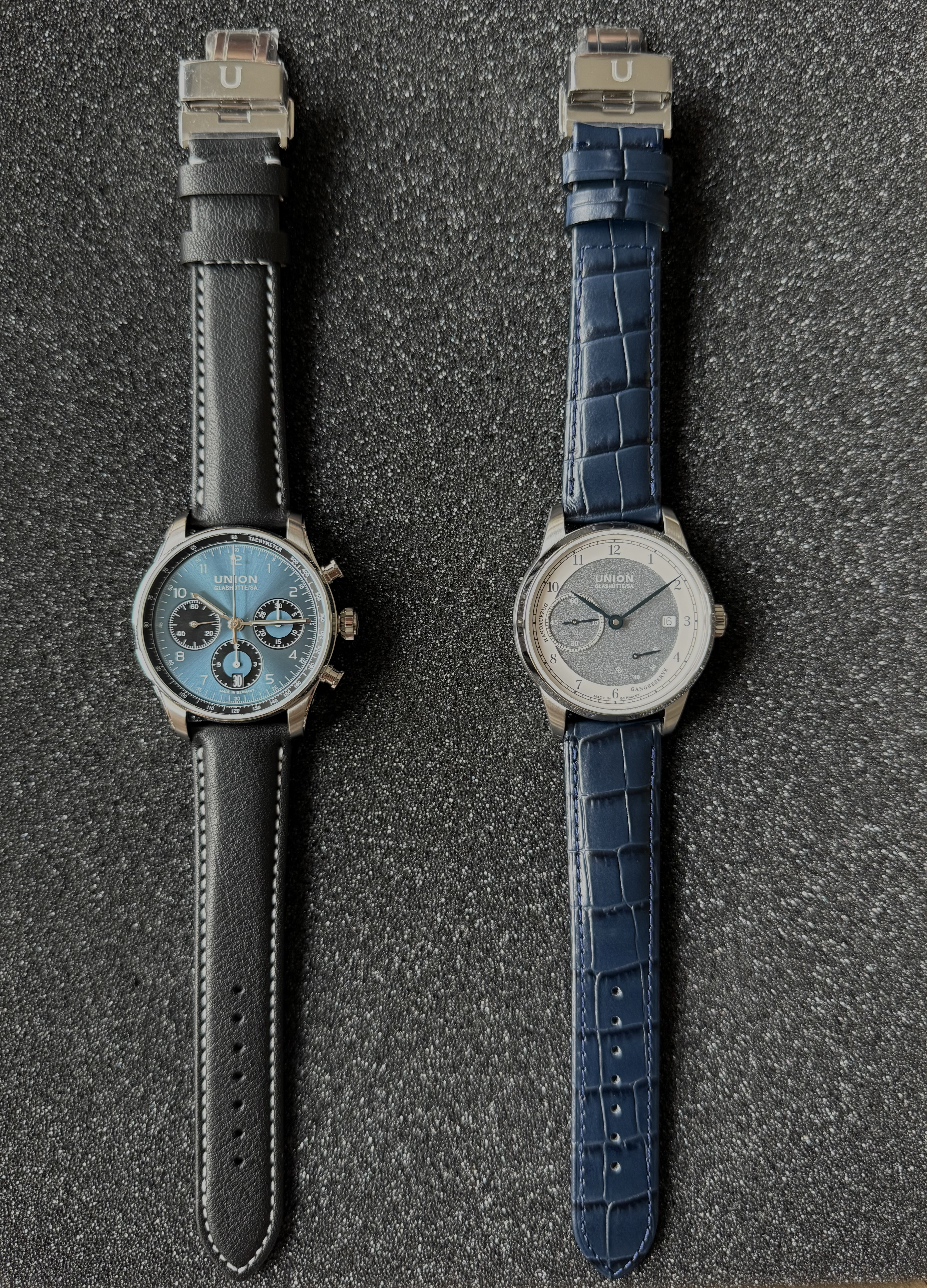
That being said, many of the decorations are unique to Union Glashütte when it comes to the calibers, and they do look stunning. For instance we currently have two of their watches in for reveiw with the respective articles scheduled to release later this week, one of them is the 1893 Jurgen Dürrstein edition which was released back in 2023 and the manual wound caliber is incredibly beautifull and if you compare it to many standard ETA manual wound calibers this one stands heads and shoulders above the rest in terms of beauty.

There you have it, this is a comprehensive overview of the history of Union Glashütte. I decided against going into detail on each watch family they produce today, as I hope to be able to go into greater detail when we review each respective family. This article is made as part of a week-long highlight of Union Glashütte, so I kindly thank them for the collaboration, and I truly recommend exploring their website.
We will be giving out three more articles this week as part of our highlight campaign and a whole host of good content on our social media channels, so I truly hope you allow us to tell you about Union Glashütte.


Leave a Reply