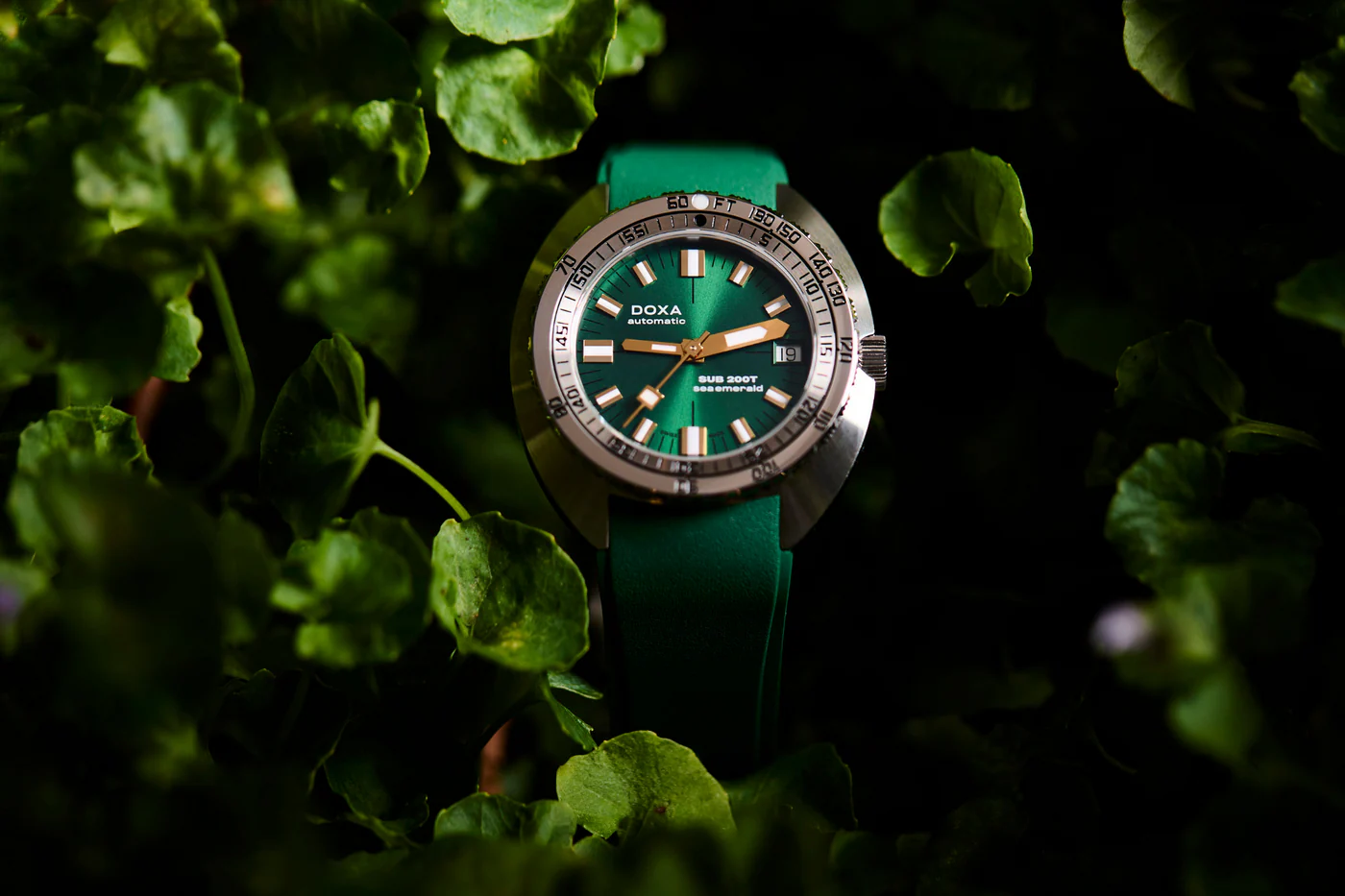
If you are part of the watch community which I expect everyone who reads this is you will know who DOXA is. If not, then welcome to an addiction that sneaks up on you, all of a sudden you’ll feel that your wallet has nothing in it except for two buttons and a tear on a picture of your ex wife who left you after you spent the kids tuition on your third watch this month. Personal tragedy aside, we all adore watches.
DOXA is very established within the community and the industry, and its specialty is dive watches. If you look over their website and their different collection, you will see that despite making tons of different watches, they are all divers’ watches in one way or another. This makes them the definition of a one-trick pony. This saying often has very bad feelings behind it. If you think of sport, it means that the subject is not versatile enough to succeed, or they are extremely predictable in their actions. DOXA is not too different.

I would argue that there can be a good reason for brands, or people, to be so-called one-trick ponies. I think brands can master a thing that makes them successful, for instance to keep on with the sports analogy, let’s look at Arijen Robben former Real Madrid and Bayern Munich footballer, he was one of the best right wingers of his time, lightning fast and with possibly the best left foot in history. One of the things that made him so great is a move that made him iconic; he would drift to the right flank, then cut inside and shoot an unstoppable shot with his left foot. This single move made him one of the more dangerous players in the world.
This move made him iconic; he was a good, even great player without it, but with the mastery of this move, he became a legend. DOXA is kind of like that; if they made a whole host of diverse watches, they would be a fine brand. They would probably still be in business, considering the heritage of the brand, but their mastery of the dive watch has made them a staple of the industry and the bar when it comes to good dive watches.

But what makes DOXA such an iconic part of watch culture? In 1889, in the legendary Swiss watchmaking town of Le Locle, a man by the name of George Ducommun. The brand was incredibly successful in the decades that followed, employing hundreds of employees and winning a whole host of prizes. In that time, they focused on pocket watches and high-end dashboard clocks for automobiles, even being on the dashboard for legendary brands like Bugatti.
In 1936 Georges Ducommun passes away, in his place comes a name many might also accociate with diver watches, Jacques Nardin, grandson of the legendary Ulysse Nardin. There unfortunately is not a lot of information to be found about Jacques Nardin or the period in between 1936-1964, at that time we start getting into their production of time instruments meant for diving.

At the time of the first DOXA diver, these tool watches were mainly used by professionals or military personnel, and they came with a hefty price tag. In 1967, at the Swiss watch trade show Baselworld, DOXA unveiled its first DOXA Sub and subsequently released it to the general public. This was the first diver built to a professional grade, made for divers but commercialized for the general public.
This watch isn’t just popular among the general public; it quickly becomes extremely popular for professionals, as this new watch comes with a revolutionary innovation. This is the first instance of a patented unidirectional rotating bezel used to time the duration of a diver underwater. This first DOXA Sub came with another iconic feature that is usually thought of when the brand is mentioned. The instantly iconic orange dial.

As much as I adore history and researching history, especially when it comes to watches. This is not a history article on DOXA, so let’s skip over half a decade to today. At this point, all the features of the iconic first DOXA Sub are present to this day, from the unidirectional bezel and the bright orange dial. Now they have expanded the line to include a whole host of bright and conservative colors, making it impossible not to find a colorway you don’t identify with.
You have 16 different lines to choose from, all based on a set size and case, whether it’s the iconic Sub 200, Sub 300, Sub 600, or Sub 1500, everyone should find something to their liking. DOXA also frequently releases new colorways and changes the small details like the bezel. From the newest batch of releases, I love the Yellow colorway on the Sub 200T watch, and it’s high on my list of potential buys.

After all of this, is DOXA a one-trick pony? The answer is an astounding, yes. Caveat being that it works in its favor, their expertise on dive watches and how well they position the brand in that regard makes it a must-have for any serious watch collector or ocean explorer. This unique positioning, where they don’t branch out of what they know, makes it so that all the pieces they have are easy to move, while also not taking things too seriously by just adding more colorways.
For me, DOXA is a must buy, for the price you pay, you get a unique piece of history and a design you can’t find in many other places. You get a well-crafted watch by a brand whose sole purpose is to sell beautiful Diving instruments.


Leave a Reply