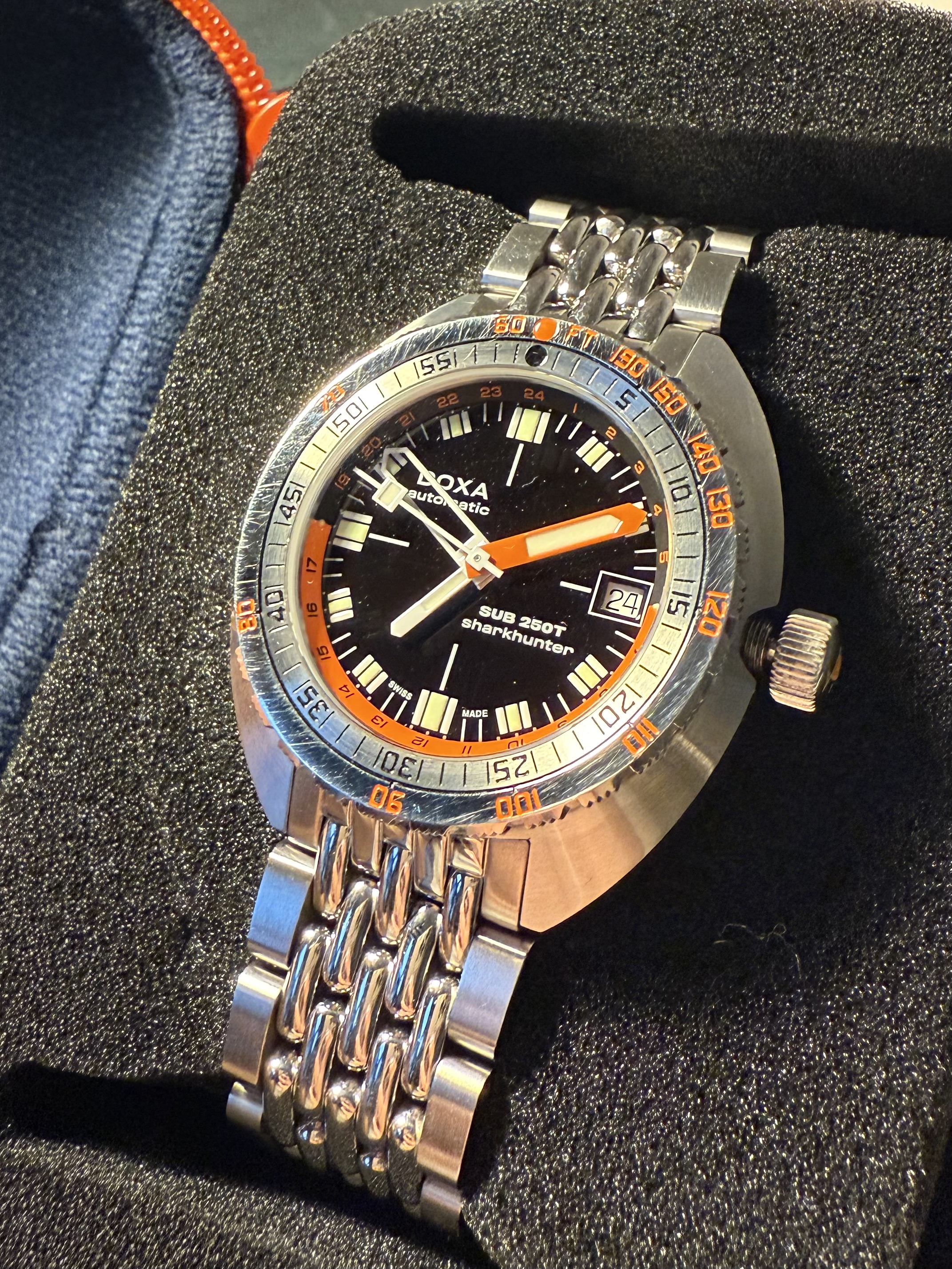
It is a bit poetic writing my first review back after a very difficult Christmas period, which saw me lose a person very dear to me. The last hands-on review we did was on the DOXA Sub 200 T. This was on the 5th of December. Now we are back with DOXA reviewing their Sub 250T GMT Sharkhunter. This review will be a bit different in tone, as the T lines from Doxa are all rather similar, so it feels almost like I am reviewing the same watch again. I will go into why that is a good thing a bit later on.
DOXA is a very old and historic brand, and the Sub lines are forefront in that development to where the brand is today. I won’t go into too much detail, seeing as I have a whole separate article for that on my page, to which I will link here. But we will go over some of the important parts. In 1889, in the Jura mountains of Switzerland, a young man by the name of Georges Duccomun founded Georges Ducommun, Fabriques DOXA. DOXA watches became a mainstay in motor racing for teams like Bugatti in the early 20th century. Right before the Second World War in 1936, Georges passed away, and in his place came Jaques Nardin, grandson of the famed Ulysse Nardin.
They kept the large production of chronographs and calendar pieces throughout the war, but the big boom for DOXA came in the 60s. Lifestyle watches became all the rage, and DOXA has a large part in that development. In 1964, the DOXA Sub was released, after being in development in collaboration with legendary diver Jacques-Yves Cousteau. The watch bore the now iconic bright orange dial as it was the most legible color as they tested the watch out by diving in Lake Nauchatel. This would then evolve and expand into more lines, like the topic of today, the Sub 250T GMT. If you want to read the full history of DOXA, I suggest you check out our previous history article talking about the brand. Which I will link here.

Now, at first glance, the Sub 250T GMT may look nearly identical to the Sub 200T, which we have previously reviewed, and in essence, it is identical. The big differences come in the form of size and caliber. The Sub 200T came in a small 39 mm, which wears very small, which I personally enjoy. The Sub 250T feels a heck of a lot larger, 40 mm, the listed difference may only be a millimeter, but it feels like a block of steel in comparison. There is a difference in thickness, which is very understandable, seeing as the 250T both has a more complicated and thus thicker movement in addition to having higher water resistance. Sub 200T being 200 meters and the 250T being 250 meters. However, the listed difference in thickness is only 0.15 mm, so it should be unnoticeable. This is making my job here a bit hard, as I can’t quite put my finger on why this watch feels so much bigger than the Sub 200T.
Let’s talk about some good things. I said in my review of the Sub 200T that I felt the sunburst blue dial disappeared due to all of the polish of the bezel and bracelet, and it would more likely than not look better if it had a matte color dial. This wound up being true, as despite the fact that I usually dislike black dials as they tend to feel a bit boring for me, this one looks phenomenal. The matte colorway is a thousand times better and more pronounced than the sunburst. Another thing I really like is how they did the GMT hand, due to the dial being small in relation to the case due to the turtle shape, there is limited real estate for additional items before it starts to feel cluttered. They went about this in a creative way by having the GMT hand be a see-through so it does not draw too much attention. The frame styling is very cool to see.

Now, one issue I have with this watch is the pricing. The watch uses a Sellita SW 330-2, which in and of itself is a pretty good workhorse of a caliber. It is decorated by DOXA, which is near pointless due to the watch having a solid case back, so you can’t see the decoration without opening the watch. This watch comes in at a price of 2590 euros. In comparison, the Sub 200T, which uses a standard Sellita SW 200-1 cost a whopping 1000 euros less at only 1590 euros. Now I would say that the Sub 200T is a much better deal and a better-fitting watch, seeing as the 250T may just be a tad too expensive for its own good.
But tell me, what do you think of the Sub 250T Sharkhunter? I personally enjoy the watch, but these issues do hamper my ability to love it. Overall, the watch gets a 7/10 for me. I want to again thank DOXA for giving me the chance to work with them, as it is always a pleasure. I will leave a link to the product page here, and I recommend taking a closer look for yourself. If you have not had your fix of me and DOXA yet, then be sure to read our previous articles with the brand. Until next time.


Leave a Reply